Introduction
Tablets are one of the most common dosage forms in the health supplement industry. The selected manufacturing process can affect powder handling, content uniformity, production control and the stability of sensitive ingredients.
Two common routes are powder direct compression and wet granulation followed by compression. From an OEM/ODM project perspective, the appropriate route depends on the formula, ingredient properties, tablet specification and confirmed quality requirements rather than on one process being universally superior.
1. Powder direct compression: a simplified process with fewer exposure steps
Powder direct compression mixes screened raw materials with suitable excipients and compresses the blend without a separate granulation stage.
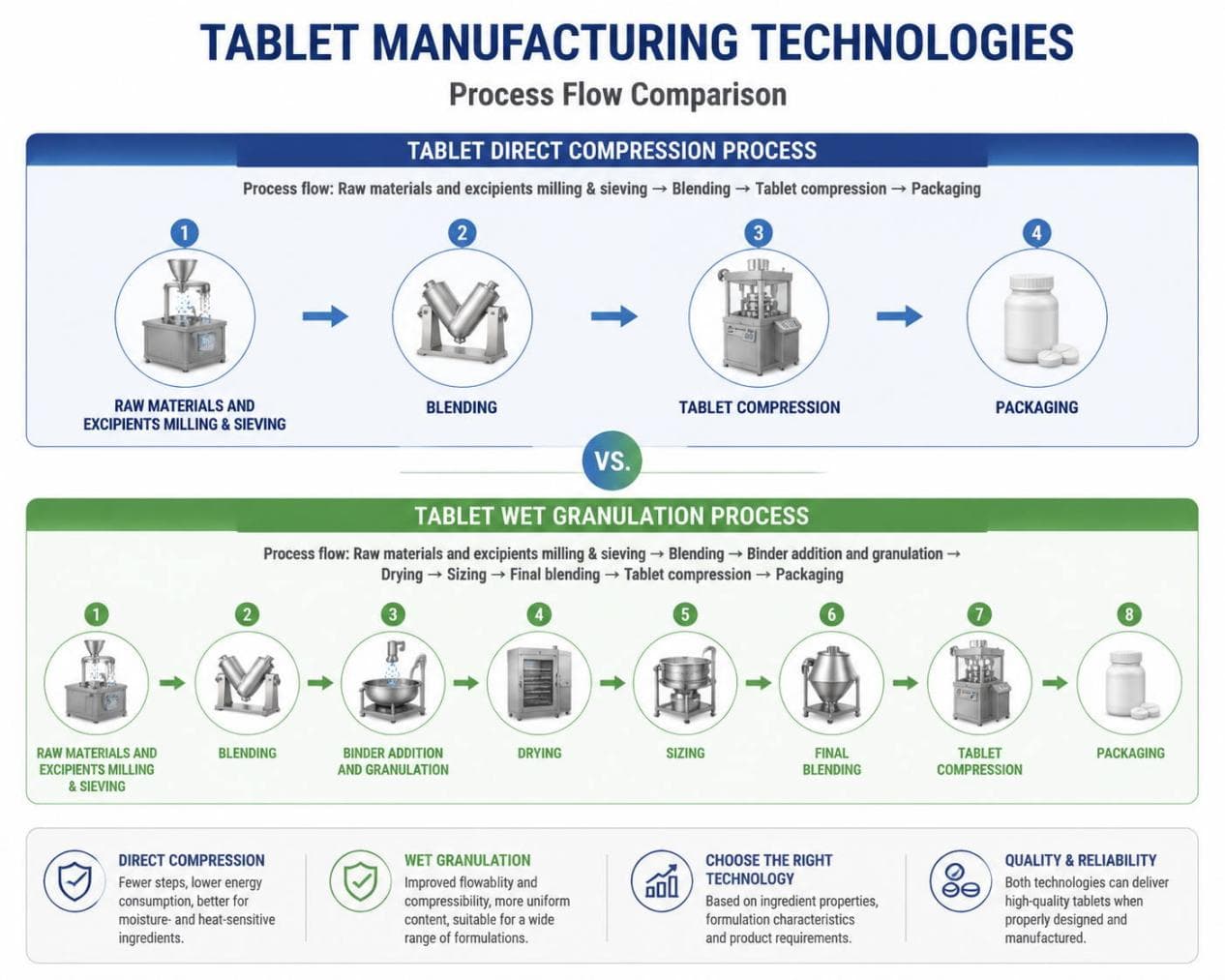
Raw material and excipient milling and sieving → Blending → Tablet compression → Packaging
Because the process does not deliberately introduce binder liquid or a drying stage, it can be a useful direction for moisture- or heat-sensitive ingredients. The shorter flow may also reduce processing time, energy use and the number of material-transfer points.
Direct compression places higher demands on powder flowability, compressibility and blend uniformity. Fine powders can feed unevenly, while density differences between ingredients and excipients can increase segregation risk. Specialized directly compressible excipients may also affect formulation cost.
2. Wet granulation: stronger material adaptability with more processing stages
Wet granulation uses a binder liquid to form granules before drying, sizing, final blending and tablet compression.
Milling and sieving → Blending → Binder addition and granulation → Drying → Sizing → Final blending → Tablet compression → Packaging
Granulation can improve flowability and compressibility for raw materials that are difficult to feed or compact directly. The resulting granules can support more consistent compression and make content uniformity easier to control for some formulation systems.
The additional exposure to liquid and drying temperatures needs careful assessment when a formula contains moisture- or heat-sensitive ingredients. Wet granulation also requires more equipment stages, a longer production cycle and additional process controls.
3. Application comparison between the two processes
The following comparison helps buyers organize an early project discussion. Final process selection still requires formulation review, pilot work and confirmed product specifications.
| Category | Direct compression | Wet granulation |
|---|---|---|
| Active ingredient protection | No deliberate wetting or drying stage; often better suited to moisture- or heat-sensitive ingredients. | Binder liquid and drying introduce additional stability variables that require formulation-specific review. |
| Process complexity | A shorter process centered on blending and compression. | Adds granulation, drying, sizing and final blending steps. |
| Material flowability | Requires suitable powder flow, compressibility and carefully selected excipients. | Granulation can improve powder flow and handling for challenging formulations. |
| Content uniformity | Segregation risk needs to be managed through material selection and blending controls. | Granule formation can make content uniformity easier to control in some formulas. |
| Cost structure | Fewer processing steps, although specialized directly compressible excipients may cost more. | More equipment time, processing stages and drying energy must be considered. |
4. Selection guidance for OEM/ODM buyers
Direct compression may be considered for formulas containing ingredients that need to avoid unnecessary moisture and heat, provided the blend can achieve suitable flow, compressibility and uniformity.
Wet granulation may be more suitable when raw materials have poor flowability or compressibility, when the formulation is complex, or when granule formation supports more stable feeding and compression.
Buyers should prepare the target market, formula direction, tablet weight and dimensions, serving plan, order quantity, packaging format and any sensitive ingredients before process review.
Conclusion
Bodakang Bio coordinates tablet OEM/ODM project communication, sample planning, quotation review, packaging discussion and production follow-up. Manufacturing feasibility is reviewed with factory support according to the confirmed formula, specification and cooperation terms.