Introduction
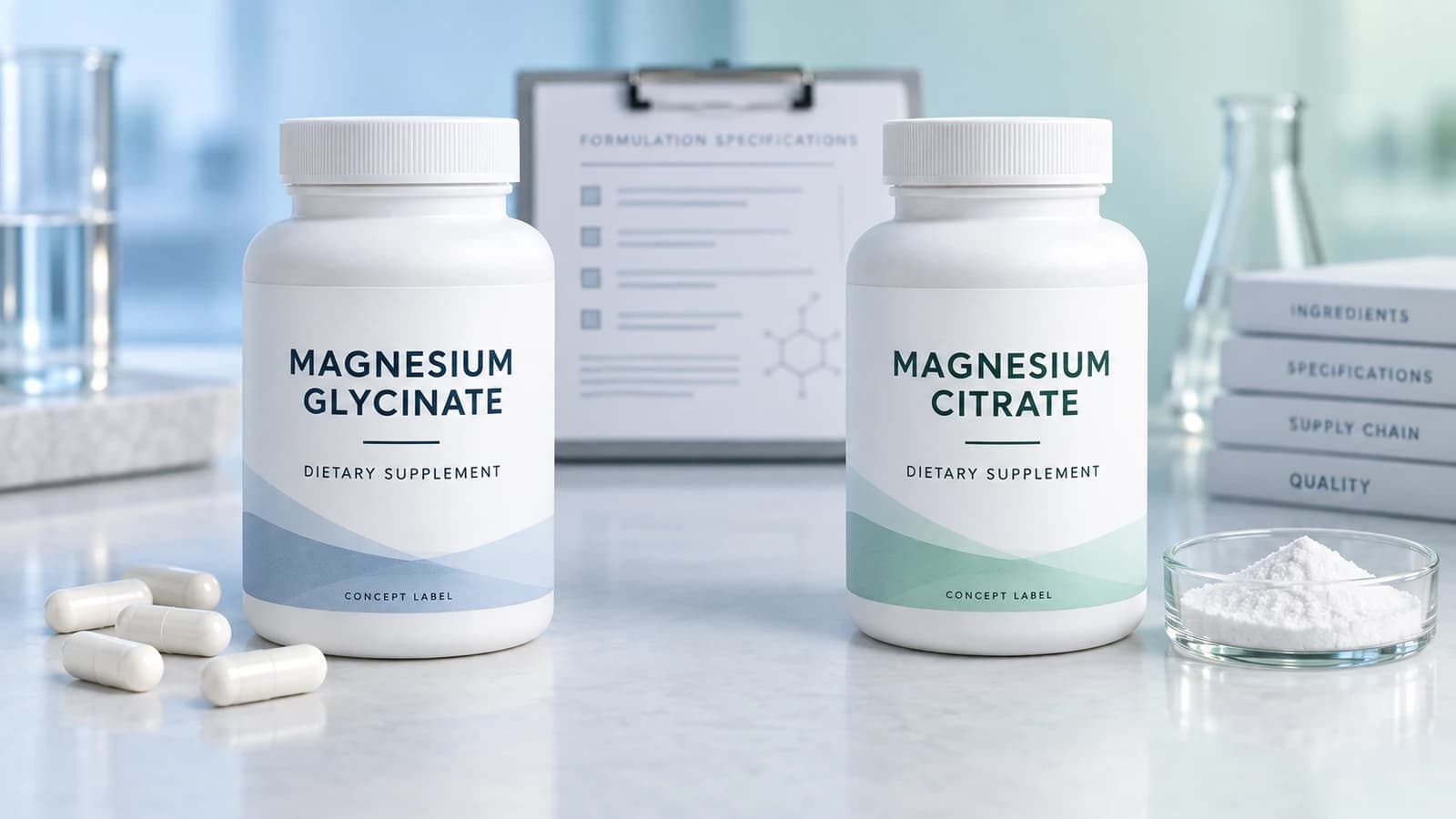
For a private label magnesium glycinate capsule project, agree on the elemental magnesium per serving, the exact ingredient specification and the acceptable number of capsules before comparing quotations. A price for “500 mg magnesium glycinate” is incomplete unless the supplier explains what that number measures and how the proposed formula fits the capsule.
The practical buying decision connects four things: the mineral your label will declare, the material used to deliver it, the capsule consumers will take and the evidence used to release the finished product. This guide helps brand owners and importers turn those decisions into a clear manufacturing brief; it does not recommend a consumer dose or promise a particular formula is suitable for every market.
1. Put elemental magnesium and ingredient weight on separate lines
An ingredient name and its weight do not tell you how much magnesium a serving provides. For a U.S.-bound dietary supplement, the Supplement Facts amount is elemental magnesium, not the weight of the magnesium-containing compound. Keep the nutrient amount and the amount of its source on separate lines in the purchasing and label review; other destinations require their own labeling check.
Ask for a formulation worksheet that separately states:
- Elemental magnesium per capsule and per serving.
- Magnesium-containing ingredient weight per capsule.
- The ingredient's magnesium assay and whether it is expressed on an as-is or dry basis.
- Capsule count per serving, total fill weight and all other ingredients.
Consider an illustrative calculation, not a proposed dose or a standard ingredient specification. If a material supplies 14% elemental magnesium on an as-is basis, providing 200 mg would require approximately 1,429 mg of that material before other ingredients:
200 mg ÷ 0.14 = approximately 1,429 mg ingredient per serving.
| Illustrative serving design | Ingredient per capsule | What still needs checking |
|---|---|---|
| Two capsules per serving | Approximately 714 mg | Space for other ingredients, powder behavior and achievable fill |
| Three capsules per serving | Approximately 476 mg | Consumer acceptance, capsule size and final serving instructions |
The 14% figure is an assumption for the calculation. Use the actual approved specification and appropriate assay basis for a real formula. Do not insert a dry-basis assay directly into an as-is calculation without the necessary adjustment. Round figures here illustrate feasibility; they are not finished-label declarations or production tolerances.
2. Define what the supplier means by “magnesium glycinate”
Make the ingredient description specific enough to compare suppliers. Request the manufacturer's specification, composition statement, identity method, magnesium assay method and a representative certificate of analysis. Ask whether the proposed material contains other magnesium sources, free glycine, carriers or processing aids.
If a quotation uses “bisglycinate,” “chelated,” “buffered” or “unbuffered,” ask the supplier to define the term for that material and support the description. A trade description alone is insufficient for approving a purchase specification. If another magnesium source contributes to the elemental total, have the contribution explained in the formulation and reviewed for accurate labeling.
Separate two questions during this review: How much magnesium is measured? What evidence supports the stated ingredient identity and composition? A total-magnesium result answers the first question; by itself, it does not demonstrate the complete identity or composition claimed for the material.
Do not approve “100% chelated,” “best absorbed” or “gentle for everyone” wording merely because it appears on a supplier presentation. Ask what evidence supports the exact statement, whether it applies to the proposed ingredient or finished formula, and whether the destination market permits it. If evidence is insufficient, remove the statement rather than turn it into your brand promise.
3. Choose capsule count after a fill-feasibility review
A capsule size is a volume constraint, not a universal weight guarantee. Request a fill trial using the proposed blend and shell rather than accepting a generic “maximum milligrams” figure as proof that your formula will fit.
Have the manufacturer report the proposed capsule size, shell type, target fill, observed fill variation and any processing adjustments needed. Discuss powder bulk density, flow, moisture behavior and the space required for other ingredients. Ask which results come from a physical trial and which remain estimates.
The main choices usually involve trade-offs:
- Fewer, larger capsules: check swallowability and confirm the full blend can be filled consistently.
- More, smaller capsules: check serving instructions, consumer preference and pack duration.
- A revised elemental target: obtain the brand's and market reviewer's approval before changing the brief.
- A different ingredient composition or format: reassess the product identity, label and commercial positioning; do not silently substitute to meet a size target.
If a vegan positioning is intended, assess the complete formula and supporting documentation as well as the capsule shell. If halal documentation is requested, confirm the relevant material, product, site, scope and validity; a shell description alone does not establish certification for the finished product.
Use Bodakang Bio's hard capsule OEM/ODM page to frame the project discussion. Treat a proposed magnesium glycinate capsule direction as a starting point for specifications, not evidence that every strength, shell or market requirement has already been approved.
4. Agree on finished-product evidence before approving the sample
Request a written testing and release plan that distinguishes incoming-material checks from finished-capsule checks. For U.S.-bound dietary supplements, review the applicable component, in-process, finished-product, packaging and labeling specifications. That U.S. framework does not certify any supplier or authorize sale in another market.
For your project, ask the quality team to define the relevant methods, limits, sampling approach and responsibility for each check. Useful approval questions include:
- How will ingredient identity and elemental magnesium be verified?
- Which finished-product tests support the declared serving and product specification?
- How will fill consistency, capsule integrity and applicable disintegration requirements be assessed?
- Which contaminant and microbiological checks apply to the formula and market?
- Which records will be available for the actual supplied batch?
Do not treat a raw-material COA as the finished-product release record. Likewise, an elemental assay alone does not establish uniformity, capsule performance, stability or compliance with every label statement. Ask what each result establishes and what it leaves unverified.
Before paying for a sample program, agree whether it covers appearance only, formulation feasibility, filling performance or further testing. Record the approved formula version, ingredient specification and packaging configuration so that later changes trigger a documented review.
5. Connect packaging to serving count and shelf-life evidence
Choose a bottle or blister after confirming the capsule dimensions and serving design. For example, 60 capsules provide 30 servings at two capsules per serving, but only 20 at three. Compare quotations on the same servings per pack as well as capsules per pack.
Request a packed sample to assess headspace, closure, label area, instructions and transport protection. For bottles, ask the packaging team whether the proposed closure, seal and any desiccant are suitable. For blisters, request the proposed material structure and the basis for its barrier selection. A pack format by itself does not establish a moisture-protection level.
If distribution includes warm, humid conditions, put the intended storage and shipping conditions in the brief. Ask what stability evidence supports the proposed shelf life in the final formula and packaging. Do not transfer an expiry period from an ingredient document or unrelated product without a suitable justification. Confirm how a change of shell, closure or packaging material affects the evidence required.
6. Review each destination market before freezing the label
Keep the ingredient form, elemental amount, daily serving, intended users and claims together in the market review. A product accepted in one country should not be assumed acceptable across Southeast Asia.
Indonesia: Ask the responsible local party to confirm the product classification, ingredient acceptability, serving, labeling and submission requirements for the specific formula. A general registration route does not establish magnesium glycinate approval for this project.
Thailand: Have the local importer check both the applicable import-premises requirements and the product-permission route, then confirm current ingredient, quantity and labeling requirements. A general route does not prove that a particular magnesium form or daily amount is permitted.
Singapore: Confirm the exact product category, including whether a vitamin/mineral-only formulation needs a different review route, before approving safety, quality, labeling, claims or advertising plans. Do not treat a general health-supplement category as an exemption from all review.
These market questions are not a product-specific authorization or a complete registration checklist. This guide does not establish Bodakang certification or a permitted dose for any of these markets.
7. Send an RFQ that suppliers can quote on the same basis
A clear request should let the supplier identify feasibility gaps before pricing. Include:
- Destination country, intended users, sales channel and proposed claims.
- Elemental magnesium per capsule and per serving, clearly distinguished from ingredient weight.
- Required ingredient identity and composition, including whether additional magnesium sources are acceptable.
- Preferred capsule count, size constraints, shell and full formula requirements.
- Capsules and servings per pack, packaging format and artwork languages.
- Initial quantity, expected reorder range and sample objectives.
- Required tests, documentation, market-review responsibilities and delivery terms.
Ask the quotation to separate formulation work, samples, testing, packaging, artwork and production, showing what is included or unresolved. Request MOQ and lead time for the exact configuration rather than assuming a general website reference applies. Agree which approvals start the production timeline.
Planning a private label magnesium glycinate capsule project? Send Bodakang Bio your manufacturing brief with the destination market, elemental magnesium target, acceptable capsule count, ingredient preferences, pack size and order quantity. Identify which details are fixed and which may change. Formula feasibility, documentation availability, MOQ, price and timing should then be confirmed against the specific project.
Buyer questions
Does “500 mg magnesium glycinate” mean 500 mg elemental magnesium?
No. Ask whether the number refers to ingredient weight or elemental magnesium and whether it applies per capsule or per serving. Compare the formulation worksheet with the proposed label before approving either.
Can an elemental magnesium test prove the ingredient is fully chelated?
An elemental result measures magnesium content. Request separate evidence appropriate to the claimed material identity and composition; do not treat the assay alone as proof of a chelation claim.
Should I choose two capsules or three per serving?
Decide after reviewing the actual ingredient assay, required blend weight, fill-trial results, capsule dimensions and consumer preference. Then check that the pack count, serving instructions and market review use the same approved design.