Introduction
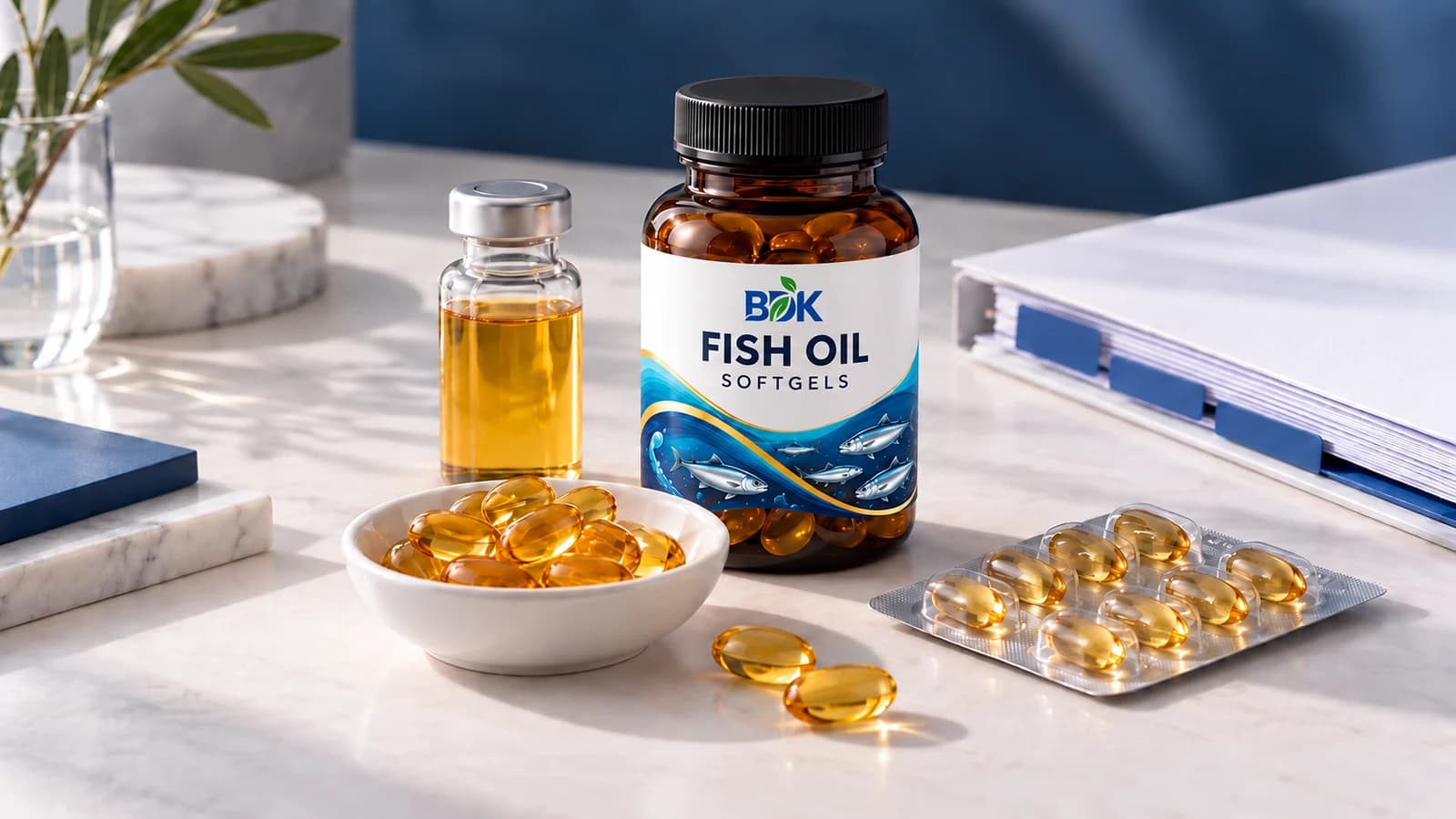
To source private label fish oil softgels, first agree on EPA and DHA per serving, oil identity, shell composition, finished-product checks and the retail pack. Compare prices only after suppliers quote the same specification. A bottle count or a headline fish oil weight alone does not define an equivalent product.
This checklist is for supplement brands, importers and purchasing teams preparing a manufacturing brief. It focuses on decisions to settle before samples, artwork approval and a production order; it does not prescribe a consumer dose.
Start with EPA and DHA, then work back to the softgel
“1,000 mg fish oil” describes an oil quantity, not necessarily 1,000 mg of EPA plus DHA. Ask for three separate quantities: oil fill per softgel, EPA per softgel and DHA per softgel. Then state the intended number of softgels per serving.
For a calculation example only, assume a 1,000 mg oil fill contains 180 mg EPA and 120 mg DHA per softgel. One softgel provides 300 mg combined EPA and DHA; a two-softgel serving provides 600 mg combined EPA and DHA and 2,000 mg of oil. These figures illustrate how to read a brief, not a recommended intake or an approved Bodakang formula.
Make the analytical basis visible. GOED’s content-expression advisory distinguishes quantities by weight from chromatographic peak area percentages. A fatty-acid profile expressed as area percent should not simply be substituted for mg/g oil when calculating label quantities.
Your specification should therefore show the measured EPA and DHA concentrations, their reporting basis, the fill weight and the proposed label declaration. Ask the laboratory or technical team to reconcile these values before approving artwork.
Choose the oil and delivery format together
Request the proposed oil’s identity, source information, processing description and chemical form—for example, triglyceride (TG), re-esterified triglyceride (rTG) or ethyl ester (EE). Put the agreed description into the purchasing specification. A phrase such as “premium omega-3” is not a substitute for it.
Avoid selecting an oil solely because a supplier calls one form superior. Require evidence for any comparative claim and review its relevance to the actual formula and market. Concentration, available source documentation, cost and the intended serving must be considered together.
An oil fill is a practical starting point for a softgel project. If you are comparing it with a hard capsule or powder, request a formulation review rather than assuming that the same liquid oil can be transferred unchanged. A powder-based omega-3 delivery system is a different ingredient and manufacturing brief, with its own loading and testing questions.
Use the Softgel Capsule OEM page to frame dosage-form discussions, and the fish oil project page to prepare product-specific requirements.
Make the shell decision before making brand claims
Ask for the complete shell and fill ingredient lists, including gelatin source or proposed alternative shell material, plasticizers, colorants, antioxidants and any other excipients. Confirm what the supplier can actually manufacture for the selected oil and size.
| Decision | What to ask for | Approval needed before ordering |
|---|---|---|
| Shell material | Exact material and animal-source information where relevant | Suitability for the brand and target market |
| Fill and capsule size | Proposed fill weight, dimensions and physical sample | Serving practicality and pack fit |
| Formula additions | Full composition, purpose and label treatment | Technical and local label review |
| Dietary or religious positioning | Evidence covering the relevant materials, site and product scope | Wording and applicable certification review |
Fish oil is fish-derived. Changing to a non-animal shell does not make the product vegan. If the project requires a vegan omega-3 direction, evaluate an algal-oil formulation separately.
Likewise, a gelatin source description does not by itself establish halal certification. Where this matters commercially, request the certificate and scope, validity, material coverage and target-market acceptance before using a claim. This article does not establish certification for any Bodakang fish oil product.
Approve a physical sample with its written specification. Keep a retained sample or an agreed reference record so later appearance or size changes can be assessed against something concrete.
Separate incoming oil evidence from finished-softgel evidence
A supplier’s oil COA and a finished-product release record answer different questions. The first relates to the oil lot; the second must connect the manufactured softgels to the agreed product specification.
Use the following evidence requests to make that distinction explicit:
- Oil acceptance: ask for identity, EPA/DHA results, oxidation and the agreed contaminant panel, linked to the supplied oil lot.
- Finished-product release: agree what will be checked on the softgels, including content verification, fill or weight controls, leakage and other relevant physical or microbiological parameters.
- Traceability: confirm how oil lots, shell materials, manufacturing batches and finished packs are connected.
- Shelf life: request the rationale and supporting stability evidence for the actual formula and proposed pack.
- Exceptions: define how a failed result, changed ingredient or revised specification will be investigated and approved.
These are buyer requests, not a statement that every listed test is performed in-house or included in a standard Bodakang quotation. Agree the test scope, responsible laboratory, methods, frequency and cost for the individual project.
Read oxidation results as a defined specification
The GOED Monograph, version 9.1, issued July 23, 2026, specifies maximum peroxide value of 5 meq/kg, p-anisidine value of 20 and TOTOX of 26 for products within its scope. TOTOX is calculated as twice the peroxide value plus the p-anisidine value. The document excludes certain delivery systems and oil types and says the p-anisidine and TOTOX provisions do not apply to flavored oils because of analytical interference.
Treat these as a stated industry reference, not a universal legal limit or evidence that a particular batch complies. Confirm applicability and local requirements with the technical team. The monograph also addresses contaminants, analytical methods and specifications throughout shelf life; one passing result at receipt is not a shelf-life demonstration.
If a supplier claims compliance, request actual results, units, methods, sample identity and test date. A “pass” statement without these details is difficult to compare.
Evaluate the pack as part of the product
Compare bottles and blisters against the actual capsule dimensions, proposed count, distribution conditions and supporting stability plan. An attractive pack should not be approved before its material and closure specification are clear.
For a bottle, ask about the bottle material, closure, seal, headspace and any proposed protection measures. For a blister, ask about the forming material, lidding, cavity size, sealing and how the selected barrier will be evaluated. Neither format automatically guarantees a particular shelf life.
Include outer-carton dimensions and shipping configuration in the review. For Southeast Asian distribution, describe expected storage and transport conditions rather than asking only for “export packaging.” Confirm whether available stability evidence supports those conditions and the proposed shelf-life statement.
Approve the packaging bill of materials, artwork and an assembled sample together. If the bottle, closure, blister material or formula later changes, ask what must be re-evaluated.
Confirm the route to market country by country
A general export document package does not establish permission to sell in every market. Assign a named local importer or regulatory adviser to confirm classification, ingredients, label text, claims and the required submission route before artwork approval.
| Market | What the official source supports | Buyer action |
|---|---|---|
| Indonesia | BPOM’s registration directorate provides health-supplement registration and classification services | Confirm the specific fish oil product category and registration dossier with the local responsible party |
| Thailand | Thai FDA’s commercial food guidance describes importer licensing and product permission routes | Have the Thai importer confirm the applicable route and current product-specific requirements |
| Singapore | HSA states that health supplements are not subject to its premarket approval, while dealers remain responsible for safety, quality and labeling | Check classification and maintain supporting product evidence; do not label the product “HSA approved” |
Sources checked on October 13, 2026: BPOM, Thai FDA and Singapore HSA. This is a planning summary, not a complete country dossier. It does not establish approval for a particular formula or brand.
Keep separate responsibility for manufacturer documents, importer submissions and label review. State who supplies each item, who approves it and when it is needed.
Send one brief that makes quotations comparable
A useful fish oil RFQ includes:
- Target country, intended customer group and proposed positioning.
- EPA and DHA targets per softgel and per serving, with the intended serving count.
- Oil fill weight, source and chemical-form preferences—or a request for technically suitable options.
- Shell requirements, capsule size preferences and restrictions.
- First-order quantity in both softgels and retail packs; pack count and number of SKUs.
- Bottle or blister requirements, label/carton scope and artwork status.
- Required tests, quality documents and market-support documents.
- Sample expectations, delivery location, trade term and desired launch window.
Ask suppliers to separate product, packaging, testing, sample-development and documentation costs. Clarify whether quantities are per formula, pack size, artwork or SKU. Ask when the lead-time clock begins: concept discussion, sample approval, deposit, material availability or final artwork approval.
Do not treat a reference MOQ as a confirmed commercial offer. Request the minimum order for the exact oil, shell, pack and testing scope. Record quotation validity and what happens if the specification changes.
Approve outputs at each project stage
Before comparing samples, approve a technical brief. Before ordering printed materials, approve the formula and market-reviewed artwork. Before production, approve the commercial scope and release specification. Before shipment, review the agreed batch and dispatch documents.
This sequence gives the buyer a concrete output to check at each stage. It also makes unresolved decisions visible before they become rework.
Discuss your private label fish oil project with Bodakang Bio
Send Bodakang Bio your target market, EPA/DHA targets, serving count, preferred oil form, shell requirements, estimated quantity and bottle or blister plan. Include any document requirements already identified by your importer.
Start with the fish oil softgel project page or submit a project brief. The next step is a project-specific review of feasibility, sampling, packaging and quotation scope. Final specifications, available documents, MOQ and delivery terms require confirmation.
Buyer questions
Does 1,000 mg fish oil mean 1,000 mg omega-3?
No. Oil weight, total omega-3 content and EPA/DHA quantities are different entries. Request the actual analytical basis and quantities per softgel and per serving.
Can one raw-oil COA approve the finished softgels?
It provides evidence about the tested oil lot. Ask separately for traceability and the agreed finished-product release checks; the raw-oil document alone does not establish the final pack’s shelf life.
Should I approve packaging before the formula?
Approve the pack alongside the confirmed formula, capsule dimensions and stability plan. A packaging decision made against a different oil, capsule or count may need further review.