Introduction
For private label buyers comparing marine vs bovine collagen powder, the first decision is which documented animal source fits the intended product and market. Then compare the specific ingredient grades on identity, allergen information, composition and sample performance. Neither source name alone establishes better efficacy, easier mixing, Halal status or suitability for your destination.
Marine collagen is a broad commercial description; ask for the actual species and tissue source. Bovine collagen identifies a cattle origin, but still needs a defined tissue source, processing site and ingredient specification. These details belong in the purchasing brief before flavor development or artwork approval.
Build a source comparison that can be checked
A useful comparison separates a source statement from the evidence behind it. Use the following matrix to screen candidate ingredients. It is a buyer worksheet, not a statement that Bodakang Bio supplies every listed option.
| Purchasing field | Marine candidate | Bovine candidate | Evidence to request |
|---|---|---|---|
| Animal identity | Exact species; do not stop at “marine” | Cattle identity and declared origin | Signed source statement linked to the ingredient code |
| Tissue and processing | Named tissue and processing location | Named tissue and processing location | Traceability summary and manufacturing flow |
| Allergen assessment | Identify fish origin and any other relevant allergens | Review the full ingredient and facility statement | Ingredient-specific allergen and cross-contact declaration |
| Ingredient composition | Collagen peptide ingredient, carriers and additives | Collagen peptide ingredient, carriers and additives | Current specification and complete composition |
| Grade characteristics | Defined molecular-weight and physical specifications | Defined molecular-weight and physical specifications | Methods, units and agreed acceptance criteria |
| Project claims | Check source and certification evidence for the proposed product | Check source and certification evidence for the proposed product | Applicable documents with scope, site and validity checked |
Keep the same ingredient code across the quotation, specification, sample label and eventual purchase order. A source declaration for a different grade does not close the identity check. Ask how a supplier communicates changes in species, origin, processing site or composition before accepting an alternative.
Treat allergens as a separate approval decision
Fish-derived collagen needs a deliberate fish-allergen review. Hydrolysis should not be used as a shortcut to an “allergen-free” statement. For example, US major-food-allergen labeling requirements include fish and apply to relevant dietary supplements; destination-specific labeling still needs its own review.
For a bovine candidate, obtain the complete ingredient and manufacturing allergen statement rather than treating the source name as proof that the finished blend is free from allergens. Flavors, other ingredients and shared handling can introduce additional considerations. A declaration about intentional ingredients and a statement about possible cross-contact answer different questions.
Before artwork approval, ask the responsible market reviewer to reconcile the ingredient list, allergen wording and source claim with the exact formula. If a field is unresolved, keep it open on the approval sheet rather than filling it with a convenient marketing phrase.
Compare ingredient grades, not source stereotypes
Collagen peptides are produced by breaking collagen into smaller fragments. Animal origin is one part of their identity; it does not describe the complete ingredient grade. Request the supplier's molecular-weight specification with its measurement method and clarify whether a figure describes an average, a range or a distribution.
Also request agreed criteria for moisture, protein or other relevant composition measures, microbiological quality and contaminants. Match methods and reporting units before comparing results. A generic technical sheet describes a grade; a batch certificate of analysis describes the identified lot. Neither should silently substitute for the other.
Avoid selecting marine powder because it is assumed to have less odor, or bovine powder because it is assumed to mix better. Evaluate the actual grade in the intended blend. Record the powder amount, liquid volume, temperature and mixing conditions before judging odor, dispersion, clumping or sediment. A supplier's ingredient sample and the finished flavored formula need separate approvals.
Keep source identity separate from serving weight
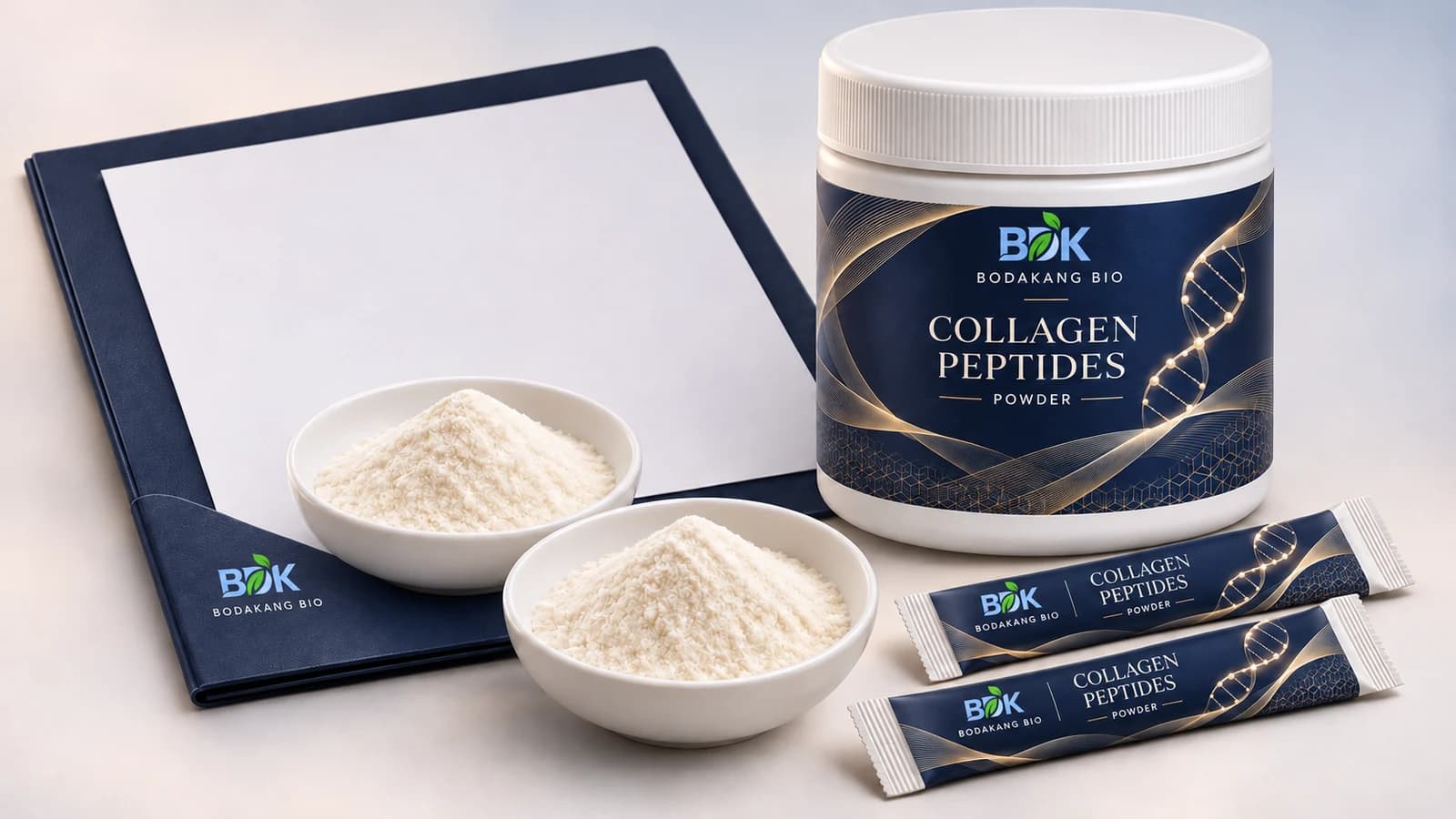
Retail powder formats illustrate why a source comparison needs more than a number on the front of a pack. A collagen-only powder, a collagen blend with another functional ingredient and a flavored sachet can have very different relationships between total powder weight and collagen ingredient content.
Write both quantities into your brief: collagen ingredient per serving and total finished powder per serving. Then ask how the proposed declaration is supported by the ingredient specification and formula. Do not equate protein grams, collagen ingredient grams and total blend grams without checking the basis.
Changing the source is also a formula change. It should trigger a review of the ingredient documents, sensory sample, finished specification and artwork. A similar-looking white powder is not sufficient evidence of equivalence.
Use a document gate before requesting final samples
Send this checklist with the sample request. The buyer and supplier should agree which documents are needed for the proposed destination and project stage; it is not a universal legal dossier.
| Document or record | Question it should answer | Buyer disposition |
|---|---|---|
| Source and composition declaration | Which species, tissue, grade and added ingredients are proposed? | Match to sample code |
| Current ingredient specification | What properties, limits, units and methods define the grade? | Resolve missing fields |
| Sample-lot COA | What results belong to the lot being evaluated? | Match lot and test scope |
| Allergen statement | What is intentionally present and what cross-contact is assessed? | Review formula and label |
| Origin and traceability summary | Which manufacturing site and supply chain support the source claim? | Record available evidence |
| Requested certification evidence | What exact ingredient, site and activity does it cover? | Check scope and validity |
| Change-control agreement | Which substitutions or process changes require notice and approval? | Agree before ordering |
If Halal documentation is required for the project, request it explicitly and verify its applicability. Do not infer certification from “marine,” “bovine,” a logo on another product or the status of an unrelated factory. Treat source eligibility, ingredient documentation and finished-product requirements as separate review points.
Buyer questions
Is marine collagen always the better private label option?
No source name is enough to establish that. Compare the documented grade against the intended market, allergen constraints, formula, sample acceptance criteria and commercial scope. An efficacy ranking is not a substitute for ingredient qualification.
Can a bovine grade replace a marine grade without changing the label?
Do not assume so. Review source wording, allergens, composition, specifications and market requirements before approving a substitution. Update the controlled formula and artwork where the review requires it.
Is a COA enough to prove the source?
Check what the actual COA covers. A lot number and analytical results should be reconciled with the source declaration, ingredient code and traceability records. A COA that lacks source information cannot independently answer every identity question.
Does Bodakang Bio have both sources confirmed for production?
Bodakang Bio's collagen peptide powder production direction is confirmed. The specific animal source, ingredient grade, supporting documents and project conditions must be confirmed individually before a supply commitment. This guide does not confirm availability of both marine and bovine grades.
Send a source-specific project brief
Start with the collagen peptides powder project page and the powder supplement OEM service. Include the destination market, preferred source and exclusions, collagen ingredient target, total serving weight, dosage form, packaging and estimated order quantity.
Send Bodakang Bio your collagen powder requirements with the source documents and sample checks you need. Ask which points are confirmed and which remain subject to ingredient sourcing, technical review or sampling. MOQ, timing, sample conditions and certification support are confirmed for the specific proposal.